
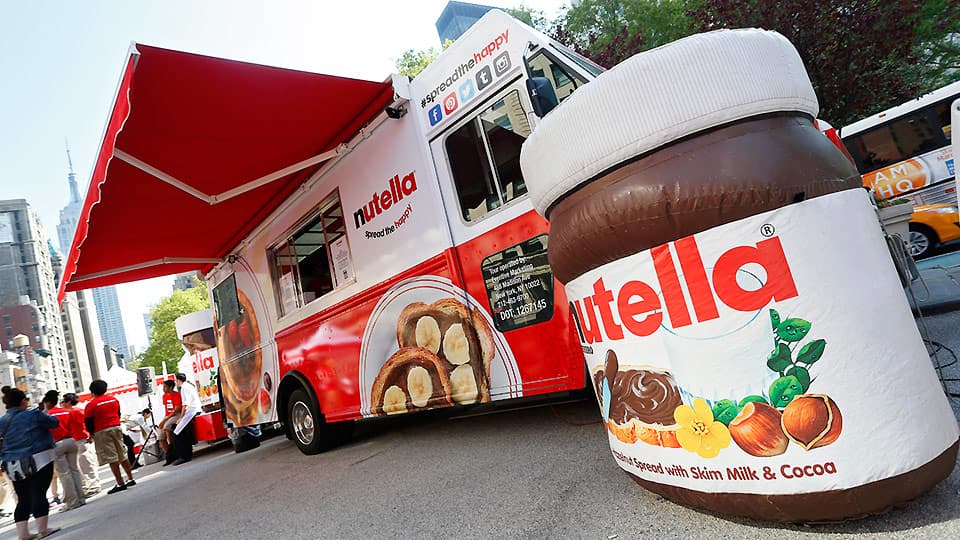
A food truck brand activation in New York City comes down to three decisions, made in this order: where the truck is legally allowed to operate, whether that truck and its team are licensed to serve food in the city, and how much lead time the permits and production need. Get those right and the creative work (the wrap, the menu, the sampling script) has room to land. Get them wrong and a beautifully wrapped truck spends launch day in a garage.
This guide is for brand managers, agency producers and corporate event planners running a branded food truck in NYC. It covers the permit routes that actually apply to promotional activity, where a truck can and can't operate, a realistic timeline, the line items that drive cost, and the mistakes we see most often. If you're comparing partners, see what's included with our food truck rental in New York. City rules and fees change, so every figure below links to its official source. Check the current version before you budget.
What is a food truck brand activation?
A food truck brand activation uses a branded, usually custom-wrapped food truck to put your product in people's hands. That might be free samples, a limited menu built around a launch, or a hosted experience for a specific audience. Two things often get confused with it:
- Food truck catering: A host pays a truck to feed guests at a private event, and the truck's own brand is the point. At an activation, your brand is the point.
- Mobile billboards: A vehicle that exists mainly to carry advertising. A food truck activation earns attention by giving people something to taste, so it tends to create lines, content and conversations, not just impressions.
In New York, the common formats are product sampling on high-traffic blocks, launch pop-ups outside retail flagships, campus and office tours, and branded trucks at festivals, conferences and sporting events.
Step 1: Set the goal and the metric before you book anything
Decide what a successful day looks like as a number: samples handed out, email or SMS sign-ups, QR scans, promo-code redemptions or user-generated posts. That number shapes every later decision. A sign-up goal needs a slower, more conversational setup and fewer, better locations. A reach goal needs high-footfall spots and a fast serving model.
Put the metric in the brief, along with the audience, target dates, a budget range and any product-handling constraints such as refrigeration, allergens or age-gating. A written brief is also the fastest way to get comparable quotes. Our guide to measuring ROI on a mobile activation covers attribution methods in more depth.
Step 2: Choose where the truck will operate
Location drives permits, cost and lead time, so decide it early. In NYC, a branded truck generally operates in one of four settings.
Private property and partner venues
This covers retail parking areas, corporate campuses, privately owned plazas, venues, stadium lots and event grounds. The property owner's permission, and their insurance requirements, is the main gate, which makes this the fastest route for many campaigns. Expect to provide a certificate of insurance (COI), a site plan and load-in times. Food safety rules still apply on private property, so confirm with your partner which Health Department permit covers what you're serving.
City streets, sidewalks and curb lanes
Promotional or commercial activity on a city street, sidewalk or curb lane needs a Street Event permit from the Street Activity Permit Office (SAPO), part of the Mayor's Office of Citywide Event Coordination and Management. SAPO's FAQ is explicit on two points: sampling from the back of a parked vehicle is prohibited, and you don't need a permit only if staff keep the items on their person and nothing (no table, cooler, banner or bag) is placed on the street or sidewalk.
SAPO sizes street events by their impact. As listed on nyc.gov in November 2026:
| Tier | Typical scope | Fee (per location, per day) | Apply at least |
|---|---|---|---|
| Small | Short activity with minimal traffic impact, such as promotional materials, a tent or a displayed vehicle on the curb lane or sidewalk | $3,100 | 14 days before |
| Medium | Commercial or promotional event with significant sidewalk and curb-lane setup, or obstructions such as tents or staging | $11,000 | 30 days before |
| Large | Extensive community and traffic impact, including a full single-block closure | $25,000 | 45 days before |
| Extra large | Multiple locations, or a combination of plazas and street closures | $66,000 | Up to 60 days before |
SAPO also requires commercial and promotional events to carry at least $1 million in liability insurance, with the City of New York named as an additional insured. Sources: CECM Street Events and the CECM FAQ.
Pedestrian plazas
Activity on one of the city's pedestrian plazas needs a Plaza Event permit, also from SAPO, with applications due 14 to 60 days ahead depending on the plaza level and the size of the event. Most plazas are maintained day to day by a local partner organization, often a business improvement district, so allow time for their input as well as the city's.
Parks
Activations in city parks fall under NYC Parks. A special events permit is required when 20 or more people will be present, with a non-refundable $25 processing fee, and Parks rules treat sampling and promotional events as concessions with additional fees that vary by park. A street permit doesn't cover a park, and a park permit doesn't cover the street. Sources: NYC Parks Special Events FAQ and Parks Rules §2-10.
Step 3: Make sure the truck can serve food legally in NYC
In New York City, a food vendor needs a Health Department vendor license (or a supervisory license), and the mobile unit itself needs a permit. Those permits have been capped for years. Local Law 18 of 2021 introduced supervisory licenses, and the Health Department says local laws 54 and 59 of 2026 will offer at least 2,200 supervisory license applications a year for five years starting July 1, 2026, first to people already on waiting lists created in 2022. Source: NYC Health: Mobile Food Vendors.
In practice, a brand usually can't buy or build a truck one month and start serving food from it in the city the next. Most activations work with a partner whose units and staff already hold the right licenses and permits, then add the brand layer on top: wrap, menu, uniforms and sampling script. Food served at temporary events such as street fairs follows its own rules, which the same Health Department page covers.
Before you sign, ask your partner to confirm in writing which permits cover your specific plan:
- The unit: its mobile food vending permit.
- The people serving: their vendor or supervisory licenses.
- The location: a SAPO street or plaza permit, a Parks permit, or the property owner's consent.
Step 4: Match the neighborhood and the moment to your audience
Foot traffic alone isn't a strategy. Choose locations by who walks past, when they walk past, and whether you can legally stop there.
| Area | Who you'll reach | Strong timing | Plan for |
|---|---|---|---|
| Midtown office corridors | Office workers, visitors | Weekday lunch | The busiest blocks are the most regulated. Budget for permits or a private plaza. |
| Hudson Yards and Chelsea | Office workers, shoppers, tourists | Lunch, weekend afternoons | Much of the area is privately managed, so owner consent comes first. |
| SoHo and Union Square | Shoppers, students, trend-led audiences | Afternoons, weekends | Crowded sidewalks. Plaza and street permits. |
| Williamsburg and DUMBO | Creative crowds, younger residents, visitors | Weekends | Waterfront parks here have their own operators and rules. Check who manages the space. |
| Long Island City and Downtown Brooklyn | Residents, a growing office base | Weekday lunch, local events | Mixed public and private space |
The calendar matters as much as the map. Brands plan around New York Fashion Week (February and September), the US Open (late August into September), Advertising Week New York (fall), the holiday season (late November through December), and summer weekends and street-festival season. Big moments mean more competition for permits and space, so start earlier for those dates. You can see how we approached another tentpole event in our look at Super Bowl LXI mobile activations.
Step 5: Build the timeline backward from launch day
Lead time is where most NYC activations get squeezed. Work backward from your date:
| Weeks before launch | What should happen |
|---|---|
| 10–12 | Sign off the brief: goal, metric, dates, budget range and location shortlist. Peak summer and holiday dates often need this much runway. |
| 8–10 | Concept, wrap design, menu or sampling plan. Confirm truck availability. |
| 6–8 | Submit location permits (SAPO needs 14 to 45 days for most tiers, and up to 60 for extra-large events and some plazas). Sign private-venue agreements. Order insurance certificates. |
| 4–6 | Produce the wrap and any fabrication. Source product. Recruit brand ambassadors. |
| 1–2 | Train ambassadors. Plan routing and overnight parking. Set a weather and backup-location plan. Set up measurement (QR codes, promo codes, tagged links). |
| Launch week | Daily setup, service, breakdown and reporting |
These are planning ranges, not promises. A single small activation on private property can move faster, and a multi-borough tour needs more time. For a deeper breakdown, see how long a mobile marketing tour really takes to plan.
Step 6: Staff for the line, not just the window
The truck gets people to stop. The team decides whether they leave with a sample, a sign-up or nothing. Plan for:
- Ambassadors working the line as well as the window: so people are engaged before they reach the front.
- A short, consistent script: what the product is, why it matters, and the one action you want (scan, sign up or redeem).
- A serving model that fits your volume goal: pre-portioned samples move far faster than made-to-order items.
- One on-site owner: for permits, the COI and conversations with property staff or police.
Our article on how brand ambassadors drive mobile tour success covers staffing in depth, and our staffing and logistics service explains what we handle on site.
Step 7: Measure the day while it's happening
Count what you said you'd count in Step 1, in real time: samples out, scans, sign-ups, redemptions and social mentions. Tag every QR code and link by location and day so you can compare spots, and agree on the report format before launch, not after. Our post-campaign reporting service is built around exactly that.
What drives the cost of a food truck activation in NYC
Every activation is priced on its own variables, so be wary of a flat number that doesn't list them. The main line items are:
- Vehicle and days: truck type, number of activation days, and travel or overnight parking in between.
- Branding: a full wrap, partial graphics, or custom fabrication such as rooftop props or a modified serving window. See our branded food truck rental options.
- Product and menu: what you serve, how much of it, and any special prep or refrigeration.
- Staffing: brand ambassadors, a team lead, and the truck's licensed operators.
- Permits and insurance: anywhere from no city permit (private property) to SAPO street event fees of $3,100 to $66,000 per location per day, plus the required liability coverage.
- Location fees: private venues, plazas and partner events may charge their own.
- Measurement and content: QR and promo-code setup, photo and video capture, and reporting.
When you compare proposals, ask for these lines separately. It's the quickest way to see whether two quotes actually include the same things.
Five mistakes that derail NYC food truck activations
- Planning to sample from a parked truck on a public street without a permit: SAPO prohibits sampling from the back of a parked vehicle.
- Wrapping a truck that isn't licensed to serve food in the city: the wrap is the easy part. Licensing isn't.
- Booking a peak date on a three-week runway: medium and large SAPO events alone need 30 to 45 days.
- Promising a drive-around as advertising: city traffic rules restrict moving billboards, and the City Council's Int. 541 of 2024 describes the existing prohibition in 34 RCNY 4-12(j). Build the campaign around permitted stops, and if a client wants drive-by visibility, confirm what's allowed before you promise it.
- Launching without a measurement plan: if you can't compare locations by day, you can't improve the next run.
Frequently asked questions
What is a food truck activation?
A food truck activation is a marketing event where a branded food truck serves samples, a launch menu or a hosted experience to a target audience. The goal is trial, sign-ups or content for the brand, not food sales for the truck.
Do you need a permit to hand out samples in NYC?
It depends on where and how. According to SAPO, you don't need a street permit if staff carry the samples and nothing is placed on the street or sidewalk. Setting up tables, coolers or banners, or sampling from a parked vehicle, on a public street requires a Street Event permit. Parks and pedestrian plazas have their own permits, and private property needs the owner's consent.
How far ahead should you plan a food truck activation in New York?
For a single day on private property, a few weeks can be enough. For anything on city streets or plazas, allow at least 14 to 60 days for SAPO alone, depending on the tier. Peak summer and holiday dates are best started 10 to 12 weeks out.
How much does a food truck brand activation cost in NYC?
It depends on the truck, the number of days, the wrap or fabrication, product, staffing, permits and location fees. City permit costs alone range from nothing on private property to $3,100 to $66,000 per location per day for SAPO street events. Ask for an itemized quote so you can compare options.
Is a food truck activation the same as food truck catering?
No. Catering feeds guests at a private event and centers on the truck's own food. An activation is a marketing program built around your brand, audience and metrics. If you only need food for a private event, a catering partner is the better fit.
Can you run the same activation in other cities?
Yes. A campaign proven in New York can be rolled into a multi-city tour with consistent branding, staffing and reporting. See our markets and nationwide tours.
Plan your NYC activation with IgnitionXM
IgnitionXM runs branded food truck activations in New York and 11 other U.S. markets. One team handles wraps and fabrication, permit coordination, brand ambassadors, routing and reporting. For Phlur, we built two custom ice cream trucks with oversized rooftop cherries and ran them in New York and Toronto.
Ready to plan? Tell us about your campaign and we'll come back with a tailored activation plan.
Explore food truck rental in New York to see vehicles, coverage and FAQs.
Fees and rules are as published by the City of New York on November 16, 2026. This guide is general information, not legal advice. Confirm the requirements for your specific activation with your partner or counsel.